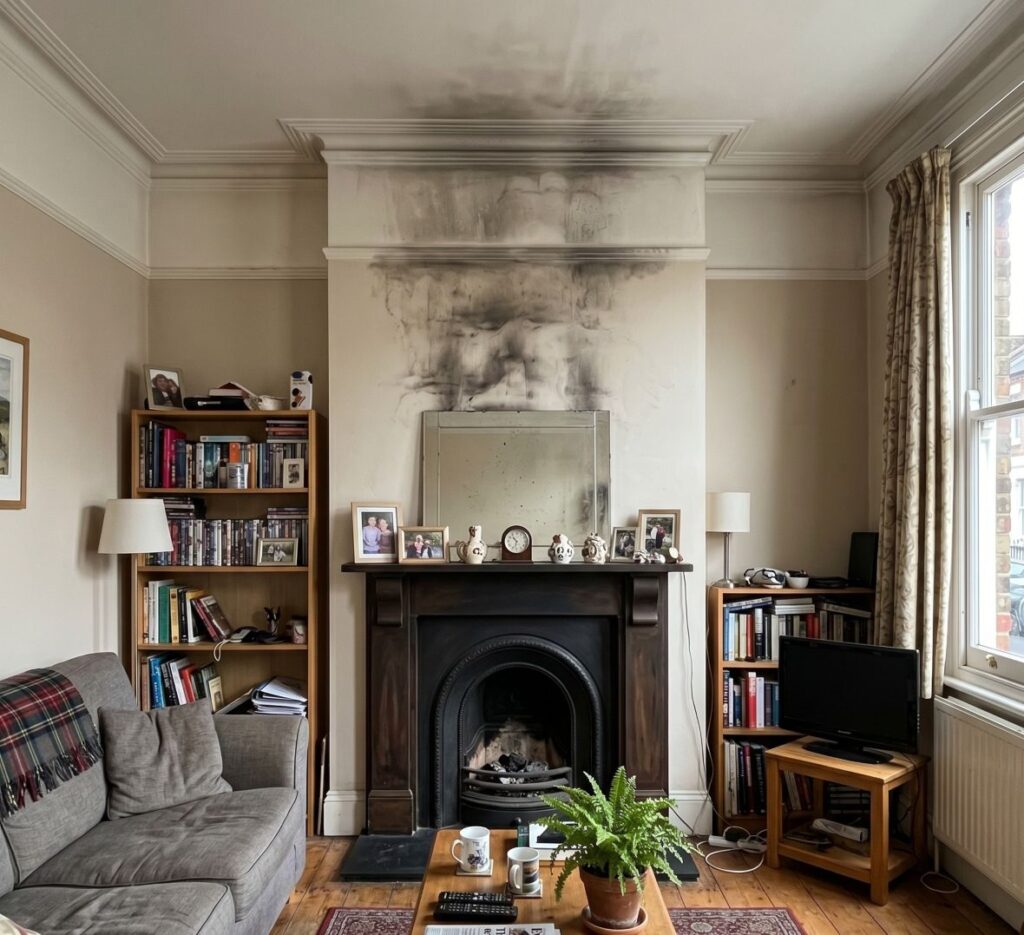
You can usually tell before you have even crossed the threshold. There is a particular smell that hangs around a flat where someone has smoked indoors for years – sweetish, stale, faintly chemical – and it greets you the second the front door swings open. Then you see the rest of it: magnolia walls gone the colour of weak tea, a ceiling that looks lightly toasted, and a film on the windows you could write your name in. Smoke-damaged rentals are the boss level of the end of tenancy world. They are not a smell problem you can solve with a scented candle and a hopeful open window, much as everyone wishes they were. They are a residue problem, an odour problem and a particulate problem all at once – which is precisely why the professional approach looks nothing like an ordinary clean.
Understanding What Smoke Actually Leaves Behind
Before you can shift smoke damage, it helps to know what you are actually fighting, because it is far more than the whiff in the air. Smoke is sneaky. It gets everywhere, and it leaves three distinct calling cards behind.
Tar, nicotine and the science of the yellow film
That tea-coloured tint on the walls is tar and nicotine, condensed out of the smoke and bonded to every surface it touched. It is sticky, slightly greasy, and stubbornly resistant to a quick wipe – which is why a damp cloth on a smoker’s wall tends to produce a brown smear and a sense of despair rather than a clean patch.
Then there is the odour, and this is the genuinely insidious part. Smoke particles are minute, so they burrow deep into anything porous: plaster, carpet underlay, curtains, even the timber of the skirting boards. The smell is not sitting on the surface waiting to be wiped away; it is embedded in the very fabric of the place. Finally there is the particulate matter, the fine ashy dust that settles on every horizontal surface and lurks in the grilles of extractor fans. Three problems, three different solutions. Treat it as one and you will fail at all three.
The First Move Is Assessment, Not a Bucket
The instinct, faced with a brown-tinged flat in Highgate, is to fill a bucket and start scrubbing immediately. This is the single quickest way to make a bad situation worse, and the professionals know it.
Reading the room before reaching for the chemicals
A proper assessment comes first. That means working out the extent of the staining, identifying which materials are involved – painted plaster behaves very differently from varnished wood or vinyl – and making the hard calls about what can be saved and what has gone past the point of rescue. In the period conversions so common around N6, with their high ceilings and original cornicing, that ceiling alone can be a day’s work, so knowing the scale before you begin is half the battle.
Crucially, the first physical job is not washing at all. It is dry removal. Professionals open everything up to ventilate, then go in with a vacuum fitted with a HEPA filter to lift the loose particulate before a single drop of water is introduced. Why the order matters comes down to that sticky tar film: introduce water and detergent too early and you will simply smear the loose deposits into a stubborn paste. Get the dry dust off first, and the wet work that follows is dramatically more effective. Patience here is not laziness; it is technique.
Stripping the Film From Hard Surfaces
With the loose material gone, the real graft begins: lifting that bonded tar and nicotine layer off the walls, ceilings, woodwork and glass. This is where the contents of the professional kit start to look rather different from the cupboard under your sink.
Sugar soap, degreasers and dry chemical sponges
For any loose soot – common where there has been a small fire rather than just cigarettes – the tool of choice is the dry chemical sponge, sometimes called a soot sponge. It is a block of vulcanised rubber used completely dry, and it lifts soot off the surface rather than grinding it in. No water, no smearing, just a sponge that turns black while the wall stays put.
For the nicotine film itself, the workhorse is good old sugar soap, that gloriously old-school British standby, often backed up by a stronger alkaline degreaser or trisodium phosphate for the worst of it. These cut through the greasy residue in a way that ordinary washing-up liquid simply cannot. The method matters as much as the product: professionals work top down, ceilings first, then walls, then woodwork, so that dirty run-off never streaks across a section they have already cleaned. Windows get the same degreasing treatment, because that hazy film on the glass is the same tar, just thinner. It is slow, methodical, slightly meditative work – and there is no shortcut that does not show.
Getting the Odour Out of the Soft Stuff
Hard surfaces, for all the elbow grease they demand, are at least straightforward. The soft furnishings are where smoke damage gets genuinely sneaky, because they have spent years quietly drinking in the odour and storing it for later.
Steam, enzymes and when carpets lose the fight
Carpets, curtains and any upholstery get treated with hot water extraction – the proper term for what most people call steam cleaning – which flushes residue out of the fibres rather than just freshening the top layer. The secret weapon, though, is enzyme-based cleaners. Rather than masking the smell with perfume, which is the air-freshener trap and never lasts, enzymes chemically break down the odour molecules themselves. No molecule, no smell. It is the difference between hiding the problem and actually solving it.
There comes a point, however, where a carpet has lost the fight. If smoke has soaked clean through into the underlay – and in a poorly ventilated basement flat it very often has – no amount of extraction will save it. The underlay acts like a sponge that has absorbed years of odour, and the only honest fix is removal and replacement. A good professional will tell you this plainly rather than charging you to steam something that was never going to come good. Knowing when to stop cleaning and start lifting floorboards-adjacent flooring is part of the expertise.
The Machines That Tackle What You Cannot See
Even after every surface has been scrubbed and every soft furnishing flushed, a faint ghost of smoke can linger in the air and in the deepest pores of the plaster. This is where the heavy artillery comes out, and it is genuinely clever kit.
Thermal fogging, ozone and hydroxyl generators
The elegant solution is thermal fogging. The machine heats a deodorising compound into a dense fog of microscopic droplets that travels exactly where the original smoke travelled, settling into the same tiny crevices and neutralising the odour at source. It is, in effect, fighting smoke with its own playbook.
Ozone generators are the other classic option, flooding a sealed room with ozone that oxidises and destroys odour molecules. They are powerful, but they come with a firm safety rule: the space must be completely unoccupied, with no people, pets or plants, while the machine runs and for a good while after. The newer, gentler cousin is the hydroxyl generator, which achieves a similar result and is safe enough to run in an occupied space, albeit more slowly. For a final passive touch, bowls of activated charcoal left around a North London flat will quietly mop up residual odours over a day or two. None of these is magic on its own, but as the finishing stage on a properly cleaned property, they are what turns “much better” into “you would never know”.
When a Clean Alone Will Not Cut It
Here is the honest truth that separates a realistic professional from an optimist with a mop: sometimes, no clean on earth will fully erase what years of smoke have done. And recognising that line is itself a mark of expertise.
Stain-blocking primers and knowing where cleaning ends
Deep nicotine staining has a maddening habit of bleeding back through fresh emulsion, so that a wall painted over without preparation turns faintly yellow again within weeks, like a stain in a horror film that refuses to stay buried. The professional answer is a shellac or oil-based stain-blocking primer, applied to seal the residue permanently before any decorative paint goes near it. Strictly speaking this crosses the border from cleaning into redecoration, and that is the point worth understanding: there is a threshold beyond which a smoke-damaged surface needs sealing and repainting rather than simply washing. A clean restores what can be restored. Past that, you are into restoration proper. Knowing exactly where one ends and the other begins is the difference between a flat that passes inspection and one that quietly turns tea-coloured all over again come the next tenancy.