There are few words in the service industry as reassuring, and as quietly slippery, as “guaranteed”. It lands on the page like a warm handshake. Book your end of tenancy clean, the listing says, and if anything is not up to scratch we will come back and put it right – guaranteed. Cue the sigh of relief from every tenant who has ever stood in a freshly emptied Highgate flat wondering whether the agent is going to find fault with the grouting. The trouble is that a re-clean guarantee, like most things that sound too good to argue with, comes with an asterisk. Several, in fact. And the gap between what people assume the guarantee covers and what it actually covers is where a great deal of avoidable frustration lives. So let us read the small print together, before the moment you actually need it.
What a Re-Clean Guarantee Actually Promises
First things first, because this is the bit most people get pleasantly but incorrectly wrong. A re-clean guarantee is not your money back. It is something rather more specific.
It’s a free return visit, not a refund
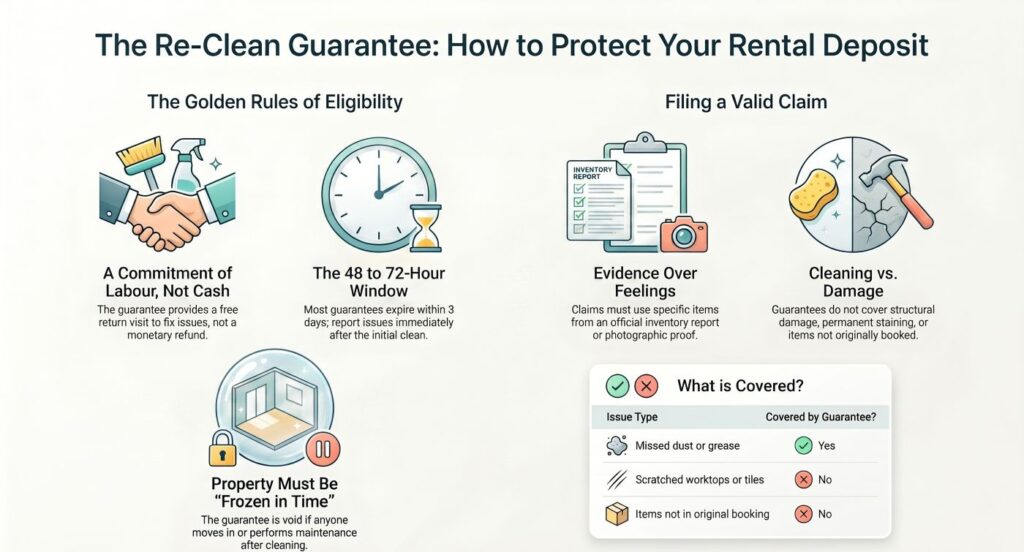
The promise on offer is this: if the property is inspected and found wanting on cleanliness grounds, the company will return and clean the flagged areas again, free of charge. That is the entire mechanism. It is a commitment of labour, not a commitment of cash. Confuse the two and you are setting yourself up for a disappointing phone call.
This matters because tenants under deposit pressure sometimes assume that “guaranteed” means they can demand a refund if they are unhappy, or threaten one to speed things along. They cannot, generally, because that was never the deal. The guarantee exists to protect the standard of the work, not to function as a customer satisfaction lever. A reputable firm stands behind its clean by fixing it, which is, when you think about it, the more honest offer. Anyone can refund their way out of a complaint. Coming back to do the job properly is the one that actually solves your problem – which, since the problem is usually an inventory clerk’s checklist standing between you and your deposit, is exactly the outcome you need.
The Clock Is the First Condition
Every guarantee worth the pixels it is printed on has a time limit, and this is the condition people trip over most often. The clean does not come with a lifetime warranty, and there are sound reasons for that.
Why the 48 to 72 hour window exists
Most firms set their window at somewhere between 48 and 72 hours from the time of the clean, though some stretch to five or even seven days. Report a problem inside that window and you are covered. Ring up a fortnight later and you will, quite reasonably, be told the moment has passed.
The logic is not corporate stinginess; it is physics. A cleaned property does not stay frozen in pristine condition indefinitely. Dust settles, the place is opened and closed, people traipse through for viewings, and the longer the gap, the harder it becomes for anyone to say whether a smear was missed on the day or arrived three days later courtesy of an estate agent’s shoes. The tight window keeps the cause and effect honest. For tenants juggling a move across North London, the practical takeaway is simple: line your clean up close to your check-out inspection, not a week before, so that any re-clean falls comfortably inside the guarantee rather than agonisingly outside it.
The Property Has to Be Frozen in Time
If the clock is the first condition, this is the big one – the clause that voids more guarantees than all the others combined, and the one almost nobody reads until it is too late.
Empty, untouched, and exactly as the cleaners left it
For a re-clean guarantee to hold, the property must remain in essentially the same state it was in when the cleaners walked out: empty, vacant, and untouched. The instant someone moves furniture back in, starts unpacking boxes, lets the dog in, or sends the builders round to fix that wonky cupboard, the guarantee evaporates. The reasoning is airtight – once the space has been used again, no one can fairly distinguish the cleaners’ work from whatever has happened since.
There is a related condition that catches people out at the original booking stage. An end of tenancy clean is priced and guaranteed on the assumption of an empty property. If you ask the team to clean around a mountain of belongings you have not yet shifted – the sofa you are collecting tomorrow, the stack of boxes in the spare room of your N6 flat – then the surfaces hidden behind and beneath those items were never cleaned, and cannot be covered. The guarantee applies to what the cleaners could actually reach. Hand them a half-emptied flat and you have quietly hand them a half-applicable guarantee.
You Need Evidence, Not Just a Complaint
Saying you are unhappy is not, on its own, enough to trigger a re-clean. The guarantee runs on evidence, and knowing what counts saves a lot of going round in circles.
The check-out report and the photographic paper trail
What a company needs is a specific, itemised list of what fell short – ideally drawn straight from the inventory check-out report or a written note from the letting agent or inventory clerk. “The kitchen wasn’t clean enough” is a feeling, not an actionable point. “Grease residue on the extractor hood and limescale around the taps” is something a cleaner can return and address with confidence.
Photographs strengthen the case enormously, which is why the savvy move is to take dated images the moment the clean is finished, capturing the property in its just-cleaned glory. If a dispute arises later, those before shots are gold. It is worth understanding, too, that a re-clean targets the flagged points, not the whole flat. The team returns to deal with the specific failures on the list, not to perform a fresh top-to-bottom clean of areas that already passed. The guarantee is a scalpel, in other words, not a reset button – and the more precise the complaint, the more precisely it can be honoured.
What the Guarantee Doesn’t Stretch To
Here is where realism earns its keep. A cleaning guarantee covers cleaning, and there is a whole category of problems it was simply never designed to touch, no matter how reasonably you ask.
Damage, repairs and the limits of a mop
Damage is the obvious exclusion. A scratched worktop, a cracked tile, a carpet burn or a chipped door frame are not cleaning matters, and no amount of returning with a mop will resolve them. The same goes for genuinely permanent staining – the rust mark that has etched itself into the enamel, the dye transfer that has been there since two tenants ago. A cleaner can clean; they cannot perform miracles, and they cannot un-ruin something that was already ruined.
Then there is scope. If carpets were not part of the original booking, a complaint about the carpets has nothing to attach to, because that work was never done in the first place. Specialist tasks left off the order form sit outside the guarantee for the same reason. And pre-existing conditions noted on your check-in inventory – that tired grout, the marks the previous tenant left – are not on the cleaners either. The guarantee is generous within its lane, but it stays firmly in that lane.
Reading the Small Print Before You Need It
All of which leads to the genuinely useful habit: understanding the conditions while everything is calm, rather than discovering them mid-dispute when your deposit is hanging in the balance.
The questions worth asking up front
A few points are always worth establishing at the outset. How long, exactly, is the guarantee window? What does the company accept as evidence – will a check-out report suffice, or do they want photographs too? Are carpets and any specialist work included in the quoted clean, or priced separately? And what specifically voids the guarantee – is it move-in alone, or any disturbance of the property at all?
None of these questions is awkward, and any firm worth dealing with will answer them happily, because clarity up front is in everyone’s interest. The deeper point is that a re-clean guarantee is not a magic shield that makes deposit worries disappear. It is a sensible, bounded promise with a clear shape: come back quickly, on an untouched property, with a specific list, for cleaning matters only. Understand that shape, and the word “guaranteed” stops being a comforting bit of marketing and becomes what it ought to be – a practical safety net you actually know how to use.